

คลิกเพื่ออ่านบทความฉบับภาษาไทย
Lessons from Joan Magretta’s Understanding Michael Porter, part two: where superior performance comes from, and how to spot it in the numbers.
In part one, we saw how the five forces set an industry’s average profitability. Even in tough industries, though, some companies earn more than that average year after year. Michael Porter’s explanation is competitive advantage.
We draw again on Understanding Michael Porter, Joan Magretta’s guide to his thinking. As she sums it up, Porter’s prescription is to aim to be unique, not the best.
“Competing to be the best feeds on imitation. Competing to be unique thrives on innovation.”
Joan Magretta, Understanding Michael Porter
At its simplest, competitive advantage comes down to two questions:
Can the company charge more than its rivals?
Can it produce for less?
Higher price, lower cost, or both
Competitive advantage is achieved when a company can either raise its relative price, lower its relative cost, or both. “Relative” is the key word. The comparison is always with rivals in the same industry.
The advantage is built through the value chain, the sequence of activities a company performs to design, produce, sell, deliver, and support its products. To stand apart from competitors, a company maps the industry value chain, compares itself against it, and focuses on value and cost drivers.
“If your value chain looks like everyone else’s, then you are engaged in a competition to be the best.”
Joan Magretta, Understanding Michael Porter
Differentiation or cost leadership
Can the company charge more than its rivals? Differentiation means raising prices relative to competitors by delivering more value to buyers. “Being able to command a higher price is the essence of differentiation,” Magretta writes.
Can it produce for less? Cost leadership means lowering relative cost by being more cost-effective. Cost advantage, she notes, “might come from lower operating costs or from using capital more efficiently.”
Porter also mentions a third route, focus, which narrows a business to a specific segment.
In war and sports, there is only one winner. In business, there are many ways to win, and a low-cost operator and a premium brand can both reach the top of the same industry. As Magretta puts it, “multiple winners can thrive and coexist.”
Two sources of advantage
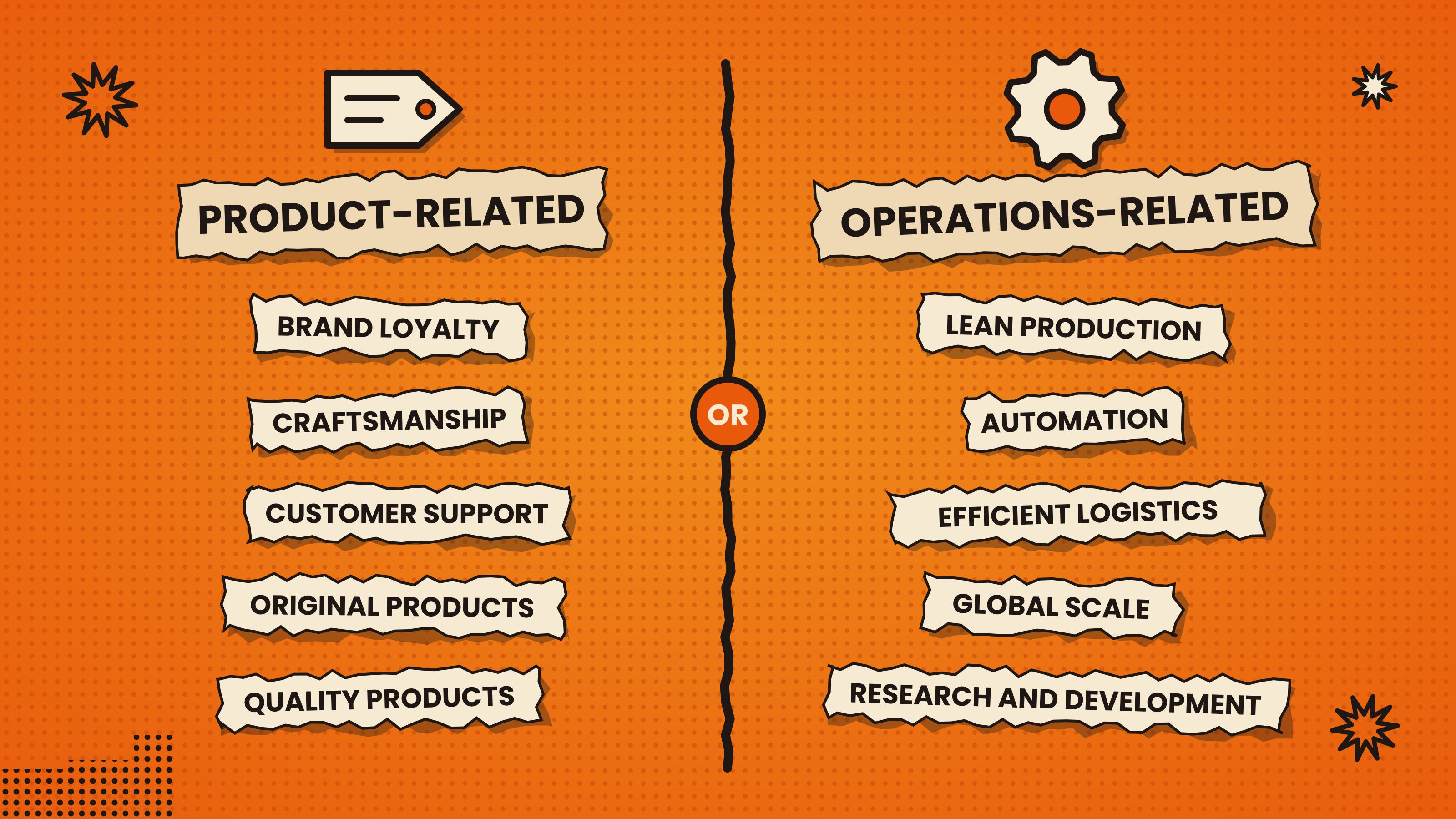
Dr. Andrew Stotz, CFA, offers a simple way to spot where an advantage comes from: the product, or the way the business operates.
Product-related advantages include brand loyalty, craftsmanship, customer support, original products, and quality products. Think of a business started by a sales or marketing person.
Operations-related advantages include lean production, automation, efficient logistics, global scale, and research and development. Think of a business started by an engineer.
Where it shows up in the numbers
Magretta ties competitive advantage directly to the P&L. A company that can charge more, or produce for less, should earn higher margins than its rivals over time.
That is what the “Sustainable” factor on our A. Stotz Stock Picking Checklist looks for: a competitive strategy that creates sustainably high gross margin. A high and stable or improving gross profit margin is financial evidence of a company’s competitive advantage. It indicates pricing power or superior cost efficiency that rivals cannot easily replicate.
We also use our World Class Benchmarking to measure whether a company has one. It ranks a company against global sector peers of similar size, from 1 (best) to 10 (worst), on the Profitable Growth metric. Our guide to reading the World Class Benchmarking triangle walks you through each level.
Five tests of a good strategy
Magretta’s book goes further, setting out five tests that a good strategy should pass:
A unique value proposition: it offers distinctive value to a chosen set of customers at the right relative price.
A tailored value chain: the way it does business is designed to deliver that value, and differs from rivals’.
Trade-offs different from rivals: it is clear about what it won’t do.
Fit across the value chain: its activities reinforce one another.
Continuity over time: its core strategy stays stable long enough for the company to get good at what it does.
For investors, the five forces and competitive advantage are a practical place to start.
Every quarter, we rank 300 Uncovered Thai Stocks and publish our Top 50, along with free reports in English and Thai. Use them as a starting point for your own research, not as investment recommendations.
Which do you think is harder for rivals to copy: a product-related advantage or an operations-related one?