

คลิกเพื่ออ่านบทความฉบับภาษาไทย
Lessons from Joan Magretta’s Understanding Michael Porter, Part 1: How to assess an industry’s attractiveness.
Two companies can be equally well run and still earn very different profits. Often the reason lies in the industry they compete in. Harvard Business School professor Michael Porter explained why in his five forces framework, first published in the Harvard Business Review in 1979.
In this two-part series, we draw on Understanding Michael Porter, a guide to his thinking by Joan Magretta, his former editor at the Harvard Business Review. Her book covers far more than we can here, so we focus on two ideas investors can apply: the five forces in this post, and competitive advantage in the next.
At its simplest, each of the five forces comes down to one question:
Are there many competitors of roughly equal size?
Could the company easily switch to another supplier?
Do customers have many alternatives?
Could a newcomer quickly match current competitors’ costs?
Could customers meet the same need another way?
Why the industry matters
A company’s profitability depends in part on the structure of its market. The five forces are a starting point for understanding how the market performs. They analyze the industry rather than any one company, though they also show where a company stands within it.
Think of an industry’s total profits as a pool shared among all participants. Each participant’s power determines how much of that profit it can capture.
“The five forces framework explains the industry’s average prices and costs, and therefore the average industry profitability you are trying to beat.”
Joan Magretta, Understanding Michael Porter
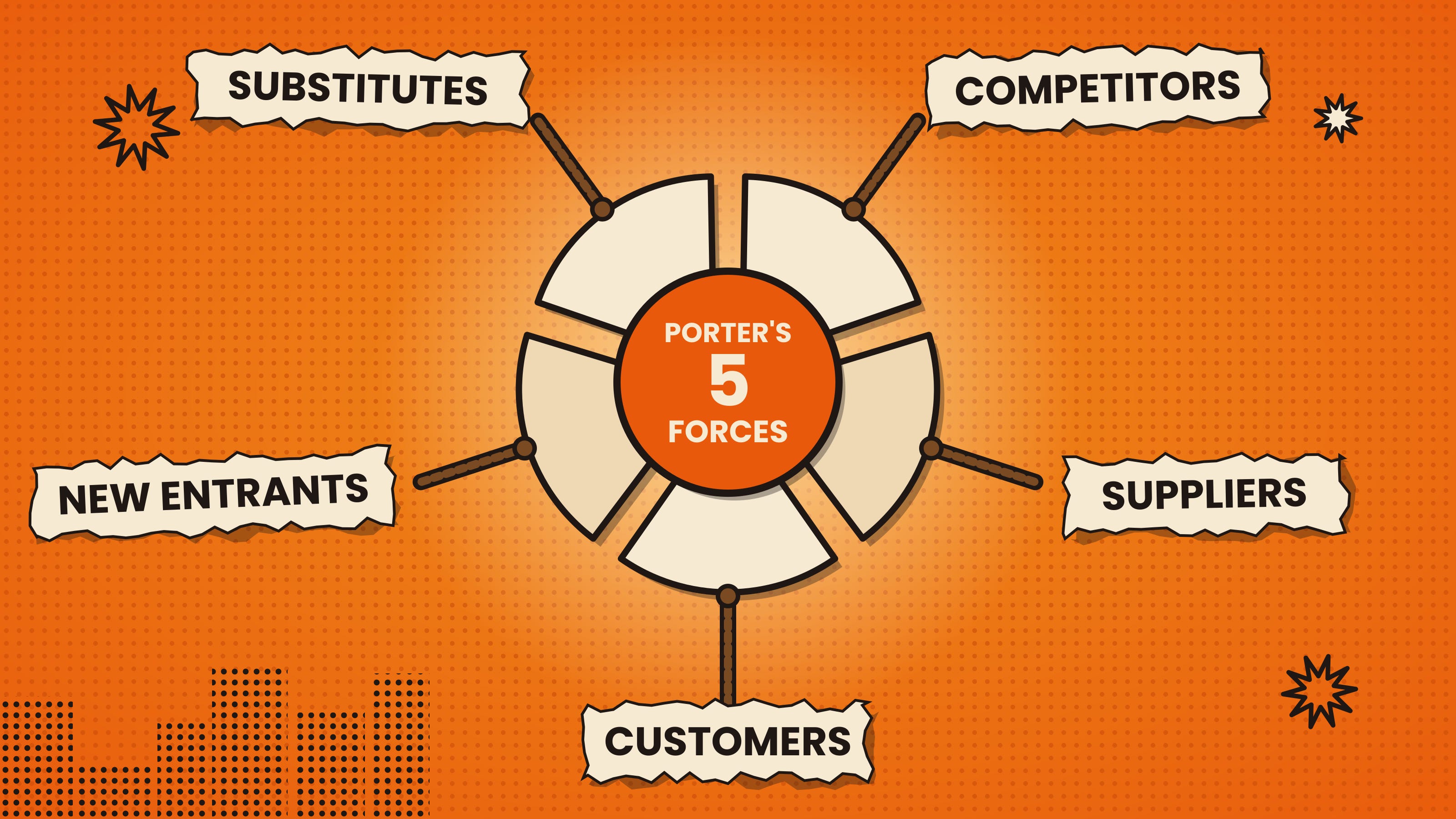
Rivalry among competitors
Are there many competitors of roughly equal size? Industries with intense rivalry are rarely attractive. Companies may resort to cutting prices to win customers, which erodes their profits.
Competing by lowering prices may work in the short run. However, in the long run, customers can’t tell one company from another because the main point of difference becomes price rather than value.
“If rivalry is intense, companies compete away the value they create…”
Joan Magretta, Understanding Michael Porter
Bargaining power versus suppliers
Could the company easily switch to another supplier? In an industry where suppliers have high leverage, they will charge companies higher prices for their products and services, especially when there is a single dominant supplier and no alternatives. A large share of the value then goes to suppliers rather than to companies, reducing industry profitability.
Bargaining power versus customers
Do customers have many alternatives? In industries where customers have high leverage, they will demand lower prices and higher value, eroding industry profitability. Customers are especially sensitive to price changes when the industry’s products are largely similar, expensive relative to their income, or of little importance to them.
Threat of new entrants
Could a newcomer quickly match competitors’ costs? Barriers to entry are low when it costs little to start a business, customers can switch easily between companies, and economies of scale are limited. These low barriers to entry reduce industry profitability.
Threat of substitutes
Could customers meet the same need another way? When many other products and services can satisfy the same needs as the industry’s own, the threat of substitutes is high. They don’t have to be the same product or service. For example, streaming films at home is a substitute for going to the movies. Having many substitutes lowers industry profitability.
Weighing up the five forces
Start by defining the industry: which products it covers and where it competes, as both shape the analysis. Then examine what drives each force and determine which matter most in that industry.
For a company, success comes from positioning itself where the five forces are weakest. For an investor, the questions are whether a company has found that position and whether it can sustain it.
The five forces in our Uncovered Thai Stocks Company Snapshots
Each of our Uncovered Thai Stocks Company Snapshots includes a Competitive positioning section. It opens with a one-sentence verdict on the industry’s attractiveness, then examines each force under the headings used here.
The next section of our snapshots, Constraints to growth, zooms in from the industry to the company. Its market constraint asks whether the pond is big enough for the fish to grow.
Coming up: Competitive advantage
The five-forces framework explains how attractive an industry is. Even in tough industries, some companies still earn more than the average. In part two, we look at how they do it and where that shows up in the numbers.
Every quarter, we rank 300 Uncovered Thai Stocks and publish our Top 50, along with free reports in English and Thai. Use them as a starting point for your own research, not as investment recommendations.
Which of the five forces do you look at first when you research a company?