

คลิกเพื่ออ่านบทความฉบับภาษาไทย
We’ve all seen the typical stock pitch. It usually involves a glossy presentation full of “massive growth opportunities,” “untapped markets,” and “synergistic potential.” But as seasoned investors know, the path to high profitability isn’t just about how fast a company can run; it’s also about the hurdles that might trip them up along the way.
If you want to truly understand a company’s future, you need to stop asking “How big can they get?” and start asking “What is stopping them from getting bigger?” This is the essence of the constraints to growth analysis we perform at A. Stotz Investment Research and apply in our Uncovered Thai Stocks Snapshots.
The power of inversion: Why thinking backward leads forward
The idea of this unconventional analysis was conceived when Dr. Andrew Stotz, Co-Founder and CEO of A. Stotz Investment Research and Alexander Wetterling, Founding Partner, were at a local spa in Bangkok, discussing how to identify future outperformers. World Class Benchmarking already tells us which companies are World Class, but picking stocks also requires you to predict which companies can improve and grow.
That’s when Alexander originated the idea: What if we analyze the constraints to growth instead of all the growth opportunities?
Invert, always invert
The rationale behind this approach is deeply rooted in a mental model popularized by the late Charlie Munger: “Inversion.” Munger often said, “Invert, always invert.” Instead of looking for ways to succeed, look for ways to fail and then studiously avoid them.
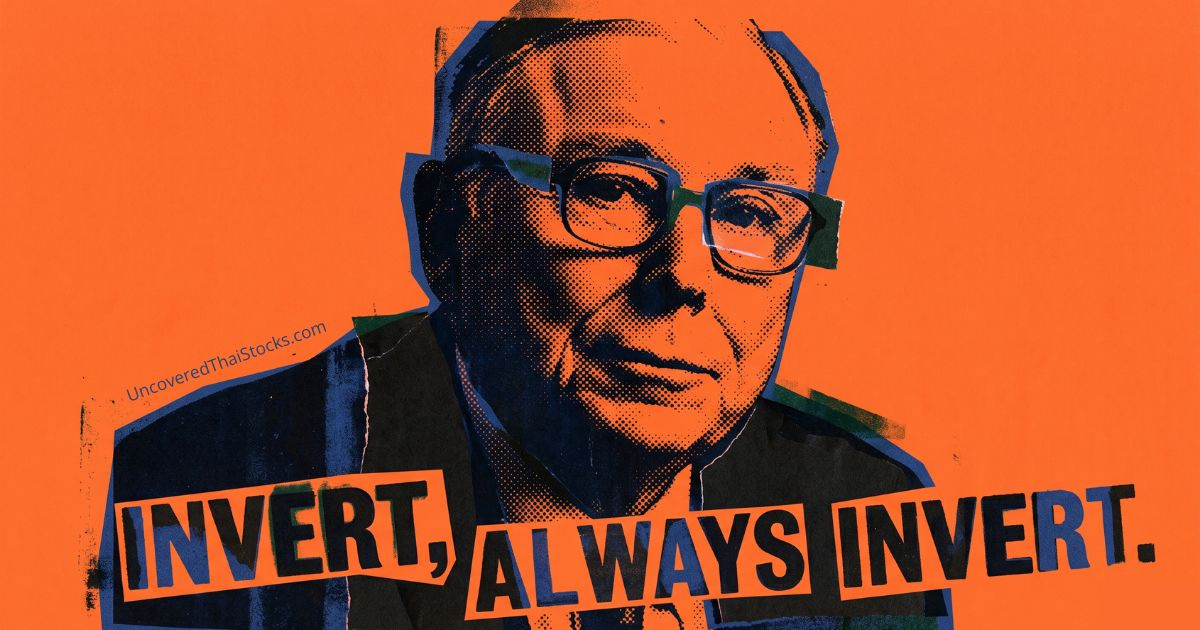
By focusing on constraints, you are applying inversion to equity research. While most analysts are busy dreaming about best-case scenarios, you are identifying the structural, financial, and operational bottlenecks that could kill a bull case. If you find the constraints manageable, you might be onto something.
Four constraints: Capital, operations, market, and people
A company needs to grow to increase profits and share price appreciation. Management’s core financial mission is to deliver this growth to increase shareholder value. Since growth is key, we like to consider constraints to growth rather than commonly discussed growth opportunities. We see four main ingredients: capital, operations, market, and people; we rank them from major constraint to minor constraint.
Capital (financial fuel)
The core question: Does the company have the cash or debt capacity to fund its aspirations, or is it running on empty?
Growth requires capital, period. To analyze a company, you can look at the cash conversion cycle and the operating cash flow. If a company must rely on external funding to keep the lights on, capital becomes a major constraint.
You can also look at the cash-to-asset ratio; a large cash pile suggests capital is a minor constraint.
Operations (the plumbing)
The core question: Is the supply chain resilient enough to handle a surge in demand, or will the “pipes” burst?
Determine whether the company relies on a single region (such as Taiwan for chips or Russia for raw materials) that is vulnerable to geopolitical shocks. Supply chain bottlenecks can halt production lines regardless of how many orders are on the books. Can the company pass higher input costs to customers?
If the primary constraint is physical production capacity, growth may require massive, time-consuming fixed-asset investments.
Market (the pond)
The core question: Is the pond big enough for the fish to grow, or is competition already suffocating the space?
Is the market approaching saturation (e.g., instant noodles in Thailand)? If so, domestic growth may be limited to market share gains, and you should consider whether the company can expand into international markets. Fierce competition for market share can lead to price wars.
Also consider if there are legal hurdles or government regulations that limit how or where the company can operate. For example, when a company becomes too big, antitrust regulators may block it from growing through acquisitions.
People (talent and succession)
The core questions: Does the company have the leadership and talent to execute, and can it attract future talent? What is the succession plan?
If the company is led by a founding family, it’s critical to understand if the next generation is expected to take over and is already integrated into the leadership team.
Consider the tightness of the labor market and the employee turnover rate.
From “what if” to “what is”
Analyzing the constraints to growth is valuable because it forces realism. It moves the conversation from “what if” to “what is.” By identifying whether a company’s bottleneck is a lack of cash, a talent shortage, or a saturated market, you can assess whether management’s mission to increase shareholder value is actually achievable.
Investors who only look at growth opportunities are looking only at the accelerator. Investors who look at constraints are also looking for roadblocks ahead.