

คลิกเพื่ออ่านบทความฉบับภาษาไทย
Most analysts’ attention in Thailand goes to the biggest names. That leaves hundreds of Uncovered Thai Stocks largely overlooked. One of them is behind a Bangkok landmark.
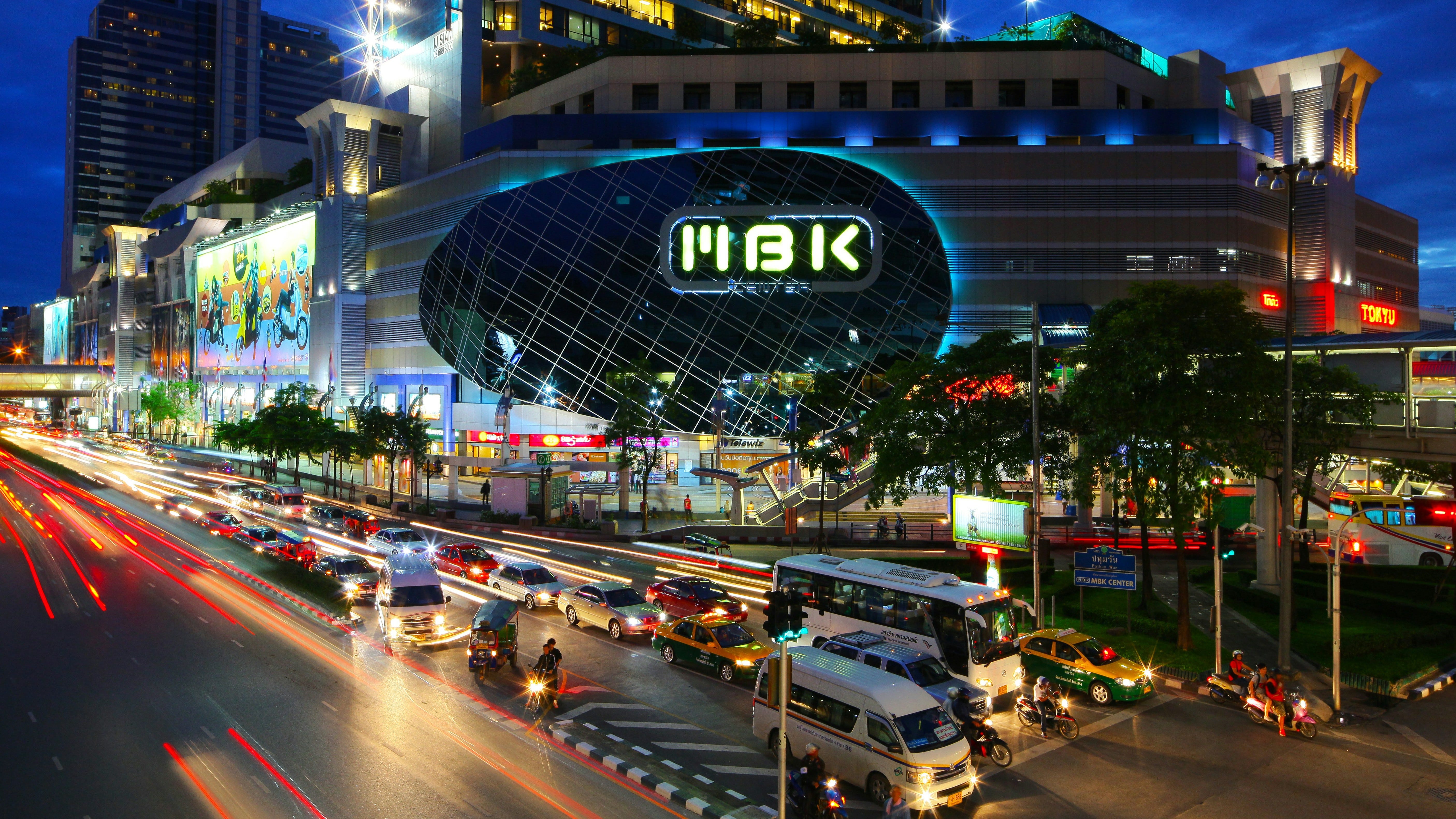
MBK Center has been a fixture at the Pathumwan intersection for decades, and in 2025 it welcomed more than 16 million international visitors. Walk into a Thai supermarket, and the same name appears again, printed on bags of Mah Boonkrong rice. For a name this familiar, it may be surprising to find MBK among the stocks we consider uncovered.
MBK ranks 41 out of 300 Uncovered Thai Stocks as of the 2Q26 financial results.
Seven businesses under one name
MBK was originally registered as Mah Boon Krong Drying and Silo Company Limited. After a series of name changes that began in 1990, it was listed on the Stock Exchange of Thailand in 1996.
Today the group runs seven businesses: shopping centers, hotels and tourism, golf, real estate, food, finance, and car auctions. MBK also holds close to half of Siam Piwat, the company behind Siam Paragon and ICONSIAM, and is the largest shareholder in Thanachart Capital PCL (TCAP).
Malls lead, rice and lending follow
Four of MBK’s seven segments account for most of its revenue.
Shopping center (31%): Anchored by MBK Center, with the Paradise Park, Paradise Place, and The Nine Center malls alongside it.
Food solution (22%): Packaged rice under the Mah Boonkrong brand, as well as rice produced for other brands and for export.
Finance (19%): Secured lending and motorcycle hire-purchase. New hire-purchase lending moved into a joint venture with a TMBThanachart Bank subsidiary in May 2026.
Hotel and tourism (15%): Includes the Pathumwan Princess Hotel, part of the MBK Center complex, plus hotels and resorts in Krabi and Phuket.
Other (13%): Car auctions, golf courses, and residential real estate.
Source: MBK Form 56-1 One Report, FY2025.

Tourism slows, competition grows
MBK’s malls and hotels rely heavily on tourism. In 2025, foreign visitors to MBK Center rose 8% even as overall tourist numbers in Thailand fell. The company credits targeted marketing, including Muay Thai and Songkran events.
2026 has brought a new headwind. MBK’s 2Q26 filings name the Middle East conflict as a cause of fewer visitors at its malls and lower occupancy at its hotels. Even so, occupancy and average rents at its shopping centers have continued to rise.
Competition is the other pressure. The company names new shopping malls and outdoor market events in Bangkok as a key challenge
Where MBK scores highest on the A. Stotz Stock Picking Checklist
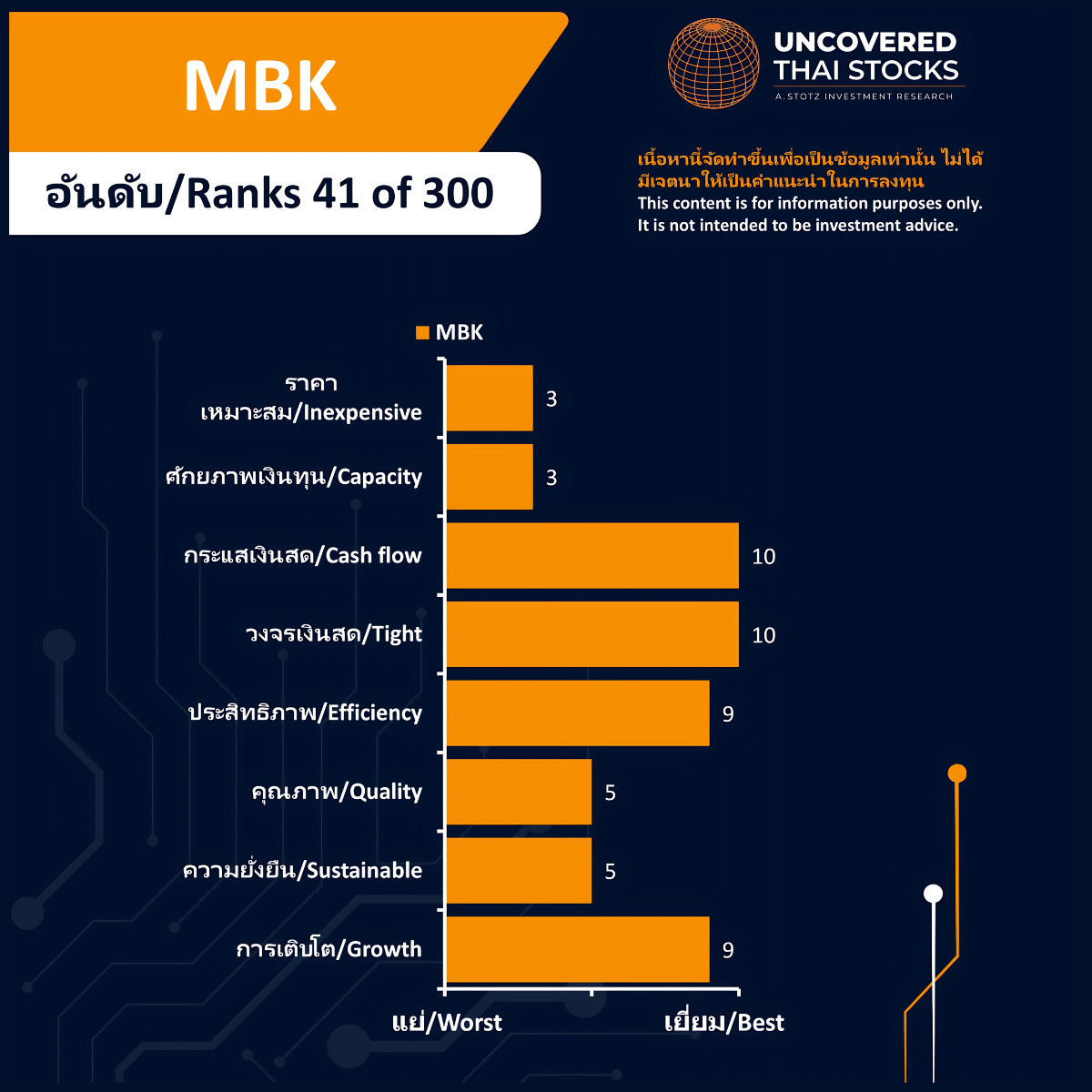
Of the eight factors on the A. Stotz Stock Picking Checklist, three stand out for MBK.
The tightness of MBK’s operation is very good based on the cash conversion cycle.
The company is very good at generating consistently positive operating cash flow.
The company has delivered strong sales growth, which is essential for long-term value creation.
Each factor comes from analyzing stocks that multiplied in value. We then backtested the best way to measure each one. Generally, the higher a stock ranks, the higher its probability of outperforming. There are, of course, no guarantees in investing: even an 80% probability event fails 20% of the time.
How MBK compares globally – World Class Benchmarking
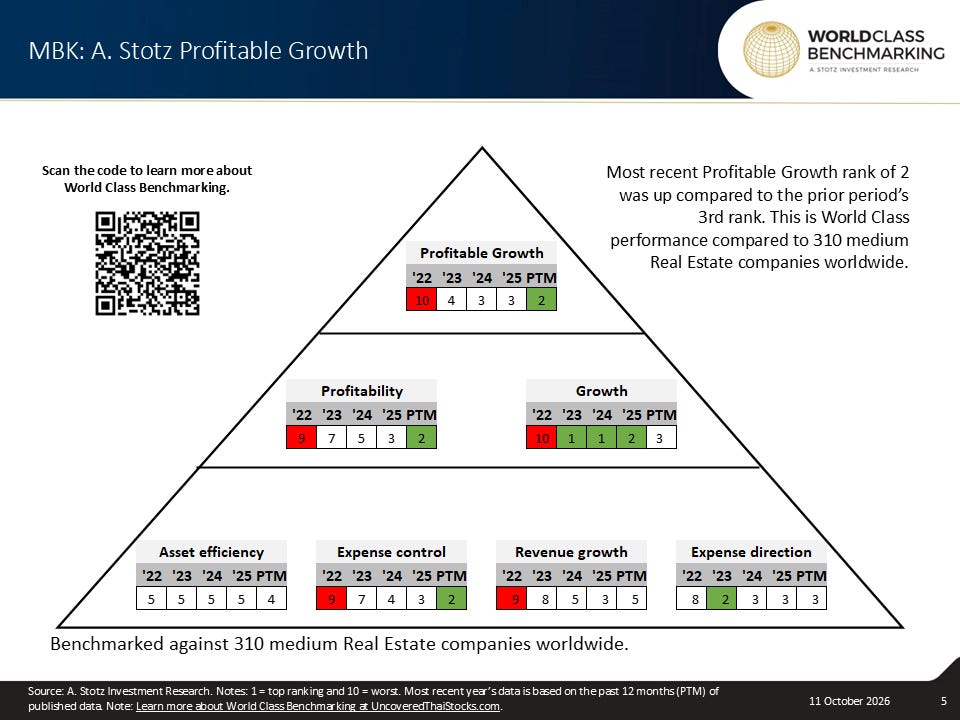
Our World Class Benchmarking ranks a company against global sector peers of similar size, from 1 (best) to 10 (worst). Profitable Growth, at the top of the triangle, is the measure that matters most.
MBK’s Profitable Growth rank has improved from 10 in 2022 to 2 over the past 12 months (PTM, as of 2Q26 financial results), which is World Class performance.
Profitability has risen from 9 to 2, and expense control has also risen from 9 to 2.
Growth has stayed in the top three since 2023.
If the triangle looks busy at first glance, our guide to reading the World Class Benchmarking triangle walks you through each level.
Constraints to growth
Market (Major): New malls continue to compete for the same Bangkok shoppers, while tighter bank lending is weighing on MBK’s real estate and car auction businesses.
Capital (Neutral): A tight cash conversion cycle and consistently positive operating cash flow help fund the business, and total liabilities fell in 1H26 as the company paid down debt and lease obligations.
Operations (Minor): With so much of the business built on footfall, MBK is exposed to events that keep visitors away, as the Middle East conflict has shown.
People (Minor): The company names successor readiness as a key risk, with measures in place to manage it.
A familiar name still adapting
A familiar name can be easy to overlook. MBK has not stood still, though. The company has repositioned Paradise Park into a health and wellness hub, and new sign-ups to its MBK PLUS loyalty program rose by 41% in 2025, with more than 1,800 merchants participating. The question is whether changes like these can keep a decades-old landmark fresh for Thai and foreign shoppers alike.
Did anything about MBK surprise you? We’d love to hear your thoughts.
Want to dig deeper? Our Reading between the lines series compares consecutive MD&As to see what’s changed and what’s worth watching.
Click here to read our latest report on MBK.
Happy days during 1997 wandering amongst the booths in MBK when I stayed at Wendy House in soi Kasemsan 1!
Interesting to read about its diversity and also how well it scores under the FRVM framework.
Best wishes,
Robert and Mallory Stockfis