

คลิกเพื่ออ่านบทความฉบับภาษาไทย
Analysts in Thailand tend to follow the largest listed companies. Hundreds of Uncovered Thai Stocks get far less attention. One of them started with a single doctor and a two-room clinic.
In 1957, Dr. Vitaya Leelawat opened the “Mor Wit” Clinic in Trang. Hospitals in the province were few, and travel in the south was difficult. A local intersection is now named in his honor. Wattanapat Hospital Trang PCL (WPH) traces its roots back to that clinic. Here, we take a closer look at the hospital group that grew from it.
WPH ranks 5th out of 300 Uncovered Thai Stocks as of the 2Q26 financial results.
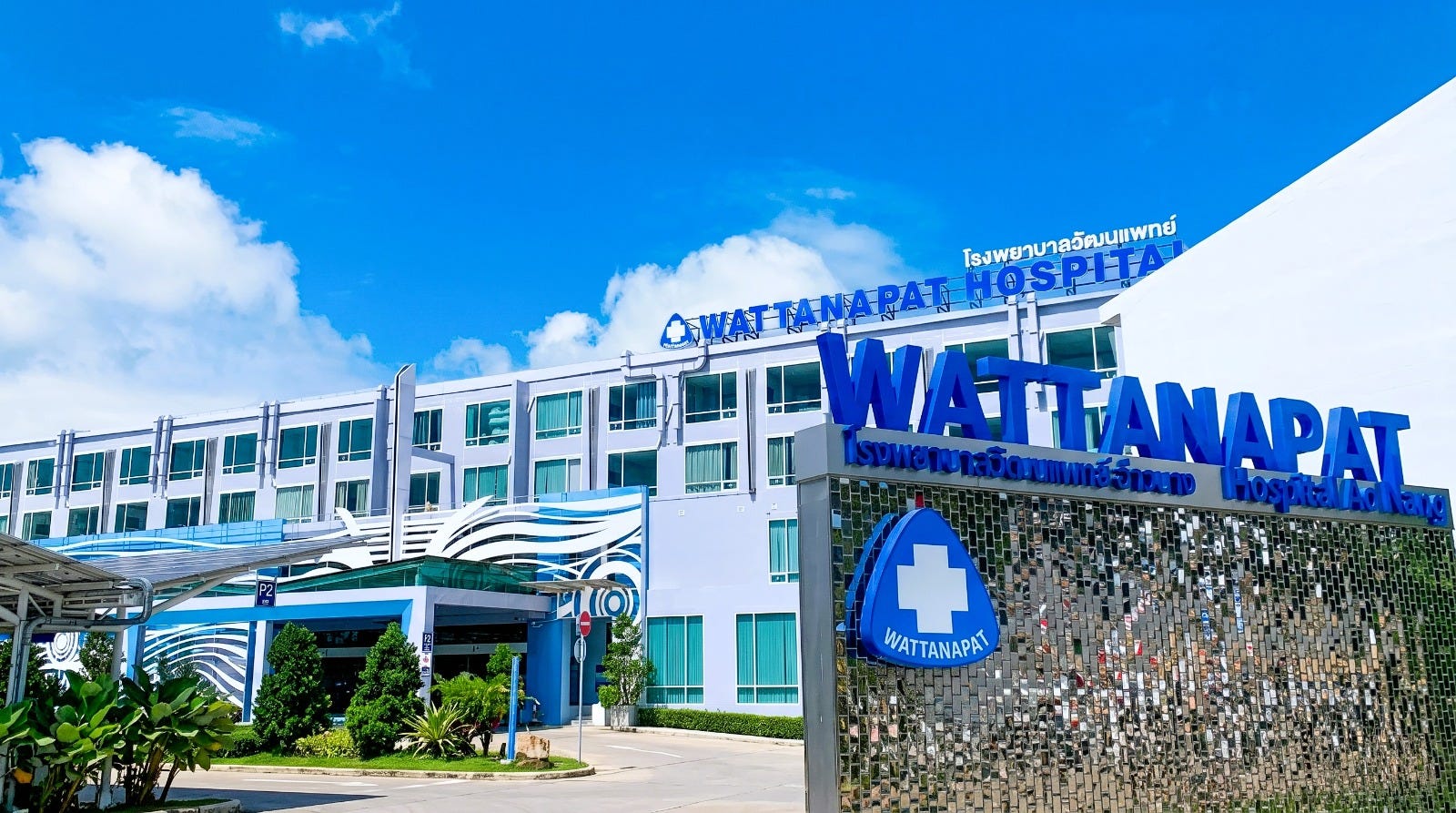
Five hospitals from Trang to Phuket
Mor Wit became the 50-bed Wattanapat Hospital Trang in 1991. It now has 120 beds, and the company was listed on the Stock Exchange of Thailand in 2017.
Since then, it has expanded to Krabi, Koh Samui, and Phuket. Wattanapat Hospital Ao Nang opened in 2019 and Wattanapat Hospital Samui in 2023. In March 2026, the 36-bed Koon Wattanapat Hospital, for elderly and palliative care, joined the group next to the Ao Nang hospital as a joint venture with Ekachai Medical Care PCL. The newest is the 200-bed Wattanapat Hospital Phuket, which opened in October 2026.
Inpatient care leads the revenue mix
WPH earns all its operating revenue from medical services, and the MD&A breaks it down three ways.
By patient type: inpatient care brought in 72% of 1H26 revenue, with outpatient visits at 28%.
By payer: insurance and corporate contracts covered 68%, and self-pay patients covered the other 32%.
By nationality: Thai patients accounted for 54% and international patients for 46%.
Source: WPH 2Q26 MD&A, 1H26 figures.

Delayed trips and more cautious patients
The company points to an aging population, rising rates of non-communicable diseases, and an emphasis on preventive care as long-term sources of demand.
Early in 2026, rerouted flights and higher airfares led some European patients to delay their trips, a challenge for WPH, where international patients account for 46% of revenue. In 2Q26, the economic slowdown made patients more cautious, and a smaller share of outpatients entered inpatient treatment. Specialized centers for complex care lifted average revenue per patient.
Where WPH scores highest on the A. Stotz Stock Picking Checklist
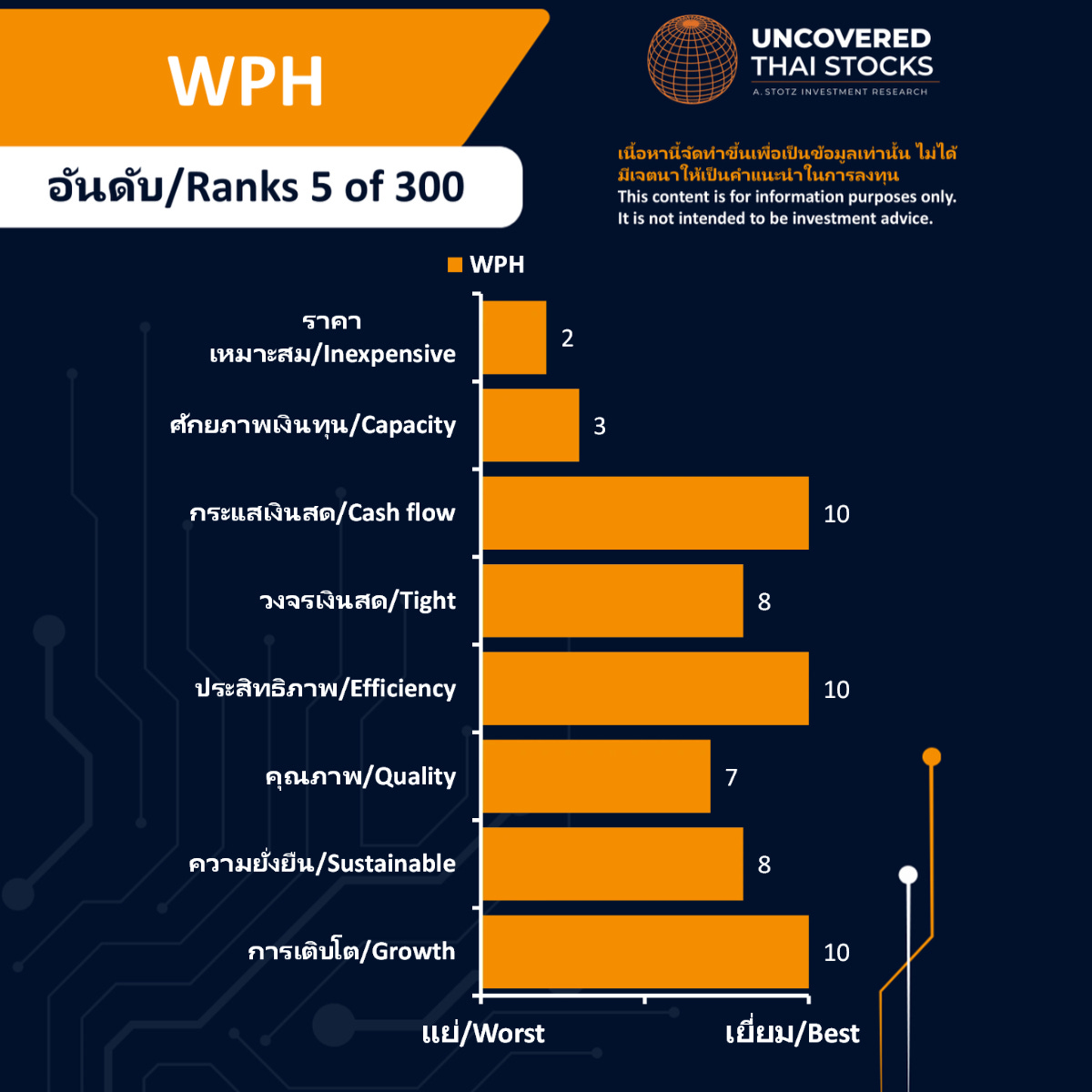
Of the eight factors on the A. Stotz Stock Picking Checklist, three stand out for WPH.
The company has delivered strong sales growth, which is essential for long-term value creation.
Its efficiency is very good when looking at the growth in sales relative to the growth in assets.
WPH is very good at generating consistently positive operating cash flow.
Each factor comes from analyzing stocks that multiplied in value. We then backtested the best way to measure each one. Generally, the higher a stock ranks, the higher its probability of outperforming. There are, of course, no guarantees in investing: even an 80% probability event fails 20% of the time.
How WPH compares globally – World Class Benchmarking
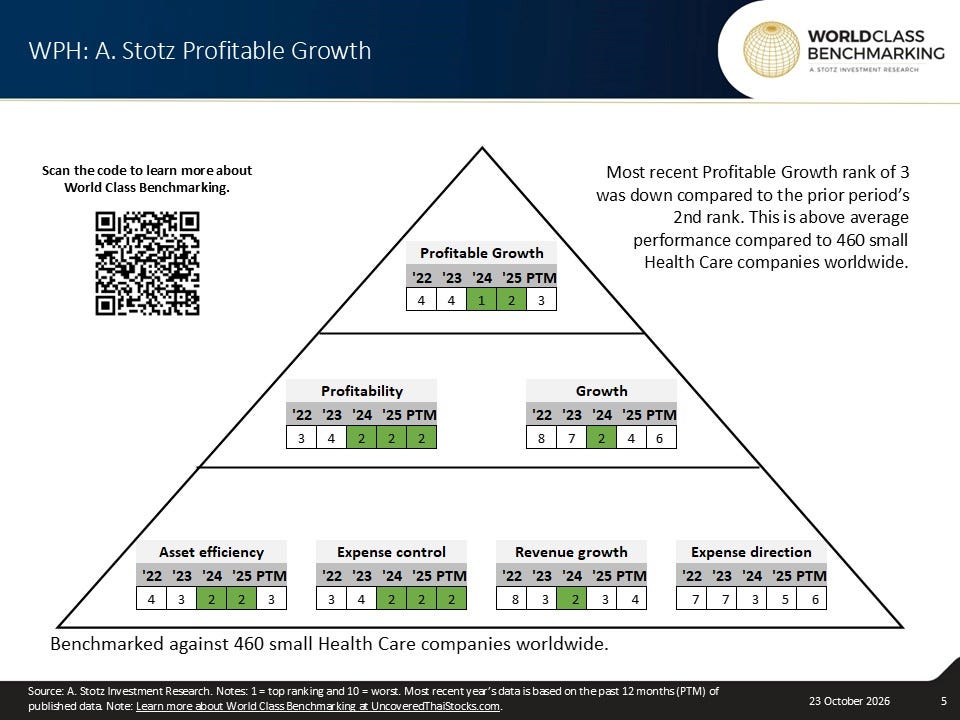
Our World Class Benchmarking ranks a company against global sector peers of similar size, from 1 (best) to 10 (worst). Profitable Growth, at the top of the triangle, is the measure that matters most.
WPH’s Profitable Growth rank was World Class at 1 in 2024 and 2 in 2025 and has eased to 3 over the past 12 months (PTM, as of the 2Q26 financial results), which is above-average performance.
Profitability is World Class and has held at 2 since 2024, as has expense control.
Growth ranked 2 in 2024 but has weakened to 6 for the PTM.
If the triangle looks busy at first glance, our guide to reading the World Class Benchmarking triangle walks you through each level.
Constraints to growth
People (Major): WPH relies on doctors, nurses, and pharmacists, and nursing staff are in short supply across the industry. On Koh Samui, specialists often come from elsewhere and tend to leave. On the mainland, the problem is finding department heads who are both managers and clinicians.
Capital (Neutral): Liabilities rose in 1H26, mainly from long-term loans drawn down to build the Phuket hospital. Dividends for 2024 and 2025 were paid partly in shares to conserve cash for the project. Operating cash flow has stayed positive, and the cash conversion cycle was shorter in 2Q26 than a year earlier.
Market (Minor): Public and private hospitals compete for patients in Trang, and foreign patient numbers can shift with global events and travel restrictions.
Operations (Minor): Opening two hospitals in one year adds pre-operating costs and the risk of cost overruns or lower-than-expected revenue. The group rotates medical staff across its hospitals.
Patient focus as a growth strategy
In our Business DNA interview, Deputy CEO and CFO Chane Laosonthorn explained how he took over a hospital built around his grandfather. He had no medical background and treated it as a set of systems and people. That outsider’s view shaped how the hospital grew.
Founder values must be translated into systems: his grandfather’s attention to every patient had to become a measurable standard the rest of the hospital could follow.
Growth requires selective investment: WPH doesn’t try to offer every procedure; it invests where there’s real patient need and refers rare cases elsewhere. Even the offices are bare; every baht goes to equipment instead.
Local healthcare providers can be partners rather than competitors: community clinics handle basic cases and send WPH those that need emergency, inpatient, or specialist care. It’s not competition; help flows both ways.
The new Phuket hospital lets WPH bring the same referral model to a new province.
You can watch the full interview with Chane Laosonthorn here.
Have you visited a WPH hospital in Trang, Krabi, Koh Samui, or Phuket? We’d like to hear your take on the company.
Click here to read our latest report on WPH.
Want to dig deeper? Our Reading between the lines series compares consecutive MD&As to see what’s changed and what’s worth watching.