

คลิกเพื่ออ่านบทความฉบับภาษาไทย
Thailand’s industrials sector rarely makes headlines the way tech or tourism does. But manufacturing, construction, and logistics form the backbone on which everything else in the economy runs, and that backbone is being reinforced right now.
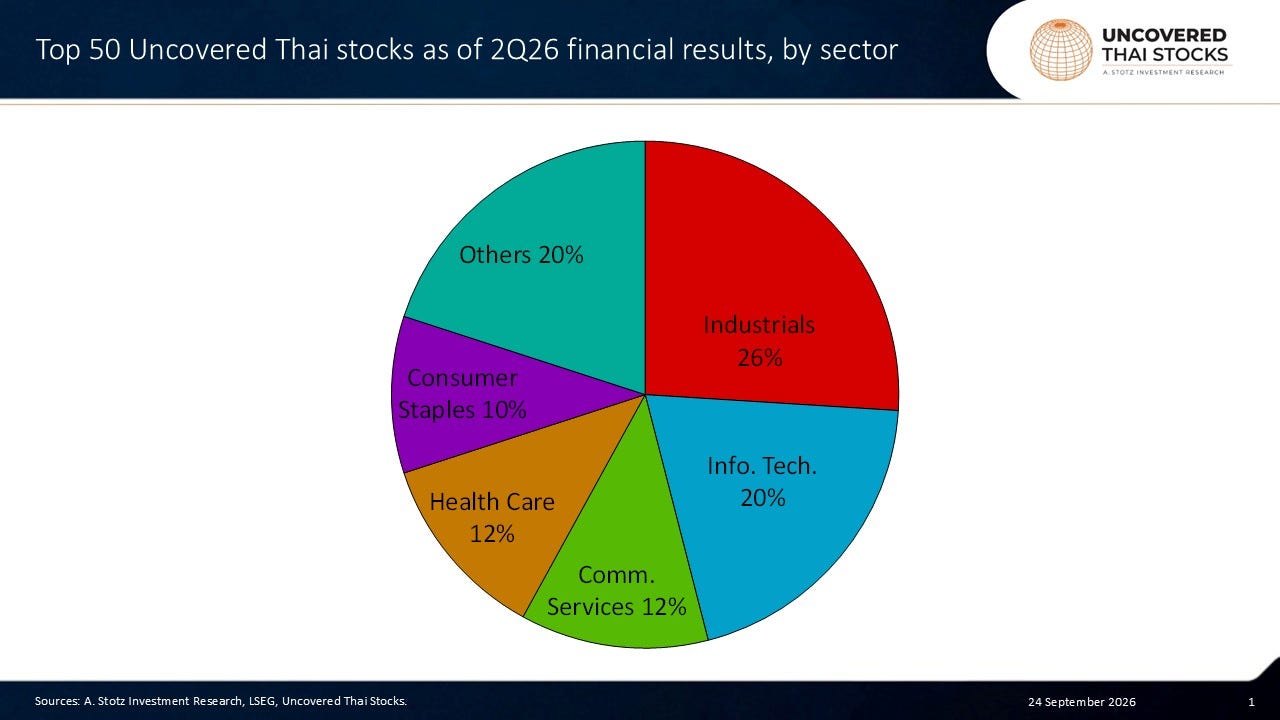
In our latest Top 50 Uncovered Thai Stocks, Industrials account for 13 companies, 26% of the list, more than any other sector, ahead of Info Tech’s 10 companies.
A quarter of the economy: falling now, but building underneath
Manufacturing accounts for a quarter of Thailand’s GDP and 16% of employment, more than 6 million jobs.
The near-term picture is subdued. Manufacturing output fell for most of 2025, and the government’s own industrial growth forecast for 2026 has been revised down, from 1.0-2.0% to 0.75-1.75%.
But investment tells a different story. Thailand’s foreign direct investment hit a record high in 2025, at more than Bt630bn, up 30% from the previous year. Despite the slowdown in output, investment is running ahead, and increasingly, it’s landing in one region.
The Eastern Economic Corridor
Most of that investment is heading east: to three provinces collectively known as the Eastern Economic Corridor (EEC). Chachoengsao, Chonburi, and Rayong account for about 13% of the country’s land area and produce roughly 15% of Thailand’s GDP.
Nine years in, the EEC already has a track record of attracting serious capital. Since its first phase launched in 2017, it has drawn close to Bt2trn in investment.
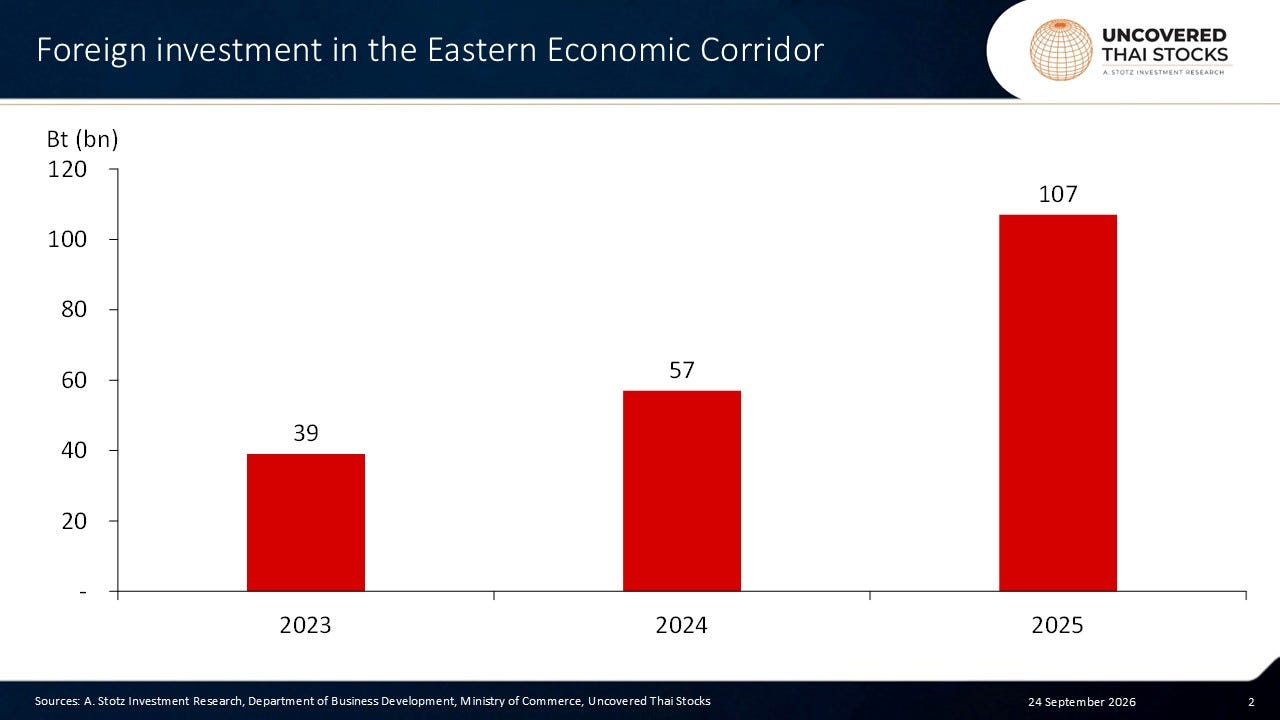
And it’s accelerating fast. Foreign investment into the EEC has nearly tripled since 2023, reaching Bt107bn in 2025.
Laem Chabang handles Thailand’s container trade. Map Ta Phut refines and exports petrochemicals. Dozens of industrial estates across the three provinces already house automotive, electronics, and EV production lines operating at scale. This is where Thailand’s industrial future is being built.
Where the hidden exposure sits
Industrials are the largest sector in our Top 50, with 13 names, representing 26% of the list. But “Industrials” is a broad category, and not every name within it belongs to the same story.
Strip away the distributors and HR platforms that share only the sector label, and four names remain with real, verifiable exposure to the EEC itself.
ATP30’s buses run almost entirely within EEC industrial estates. TEAMG lists the corridor as part of its own business segment. SYNTEC has built projects specifically for it. And PORT’s river terminal ties its growth directly to EEC trade flows.
These four companies sit right where that growth is happening, and the market hasn’t noticed them yet.
ATP30 PCL (ATP30) ranked 38th out of 300 Uncovered Thai Stocks and is very good at generating consistently positive operating cash flow. ATP30 operates a large fleet of buses and vans to transport workers from residential areas to work sites. Its operations are concentrated in the Eastern Economic Corridor (EEC), specifically serving major industrial estates.
TEAM Consulting Engineering and Management PCL (TEAMG) ranked 27th out of 300 Uncovered Thai Stocks and has delivered strong sales growth, which is essential for long-term value creation. TEAMG is an integrated consulting firm providing engineering, environmental, and management services. The company specializes in large-scale infrastructure projects, including transportation, water resources, and environmental impact assessments.
Syntec Construction PCL (SYNTEC) ranked 19th out of 300 Uncovered Thai Stocks, and looking at the balance sheet, the company has very good access to capital to fund growth. SYNTEC is a construction company specializing in high-rise buildings and complex civil engineering. The company offers a one-stop service from foundation work to architectural finishing.
Sahathai Terminal PCL (PORT) ranked 31st out of 300 Uncovered Thai Stocks, and earnings quality is very high based on our analysis of net income relative to operating cash flow. PORT is a multi-purpose terminal operator located on the Chao Phraya River in Samut Prakan. The company provides a wide range of services, including commercial vessel berthing, container storage, and inland transportation.
Built into the EEC
Thailand’s industrial base is being reinforced right now, with new estates, record investment, and ports and factories already operating at scale. The EEC is the clearest expression of that story anywhere in the country.
ATP30, TEAMG, SYNTEC and PORT operate within it, moving its workers, designing its infrastructure, building on its land, and shipping its goods. None of them have analyst coverage. The EEC is developing rapidly, and that combination could be where an opportunity presents itself.