

คลิกเพื่ออ่านบทความฉบับภาษาไทย
Mapping the coverage gap across the region
It’s easy to assume that large Asian stock markets are thoroughly researched. Our data shows otherwise: even in the region’s best-covered market, most listed companies still lack meaningful analyst attention.
We consider a stock “uncovered” if fewer than three analysts cover it, meaning an analyst published an active recommendation, target price, and forecast in the past six months. Read more about our definition of uncovered.
More than 4 in 5 listed Asian companies are uncovered
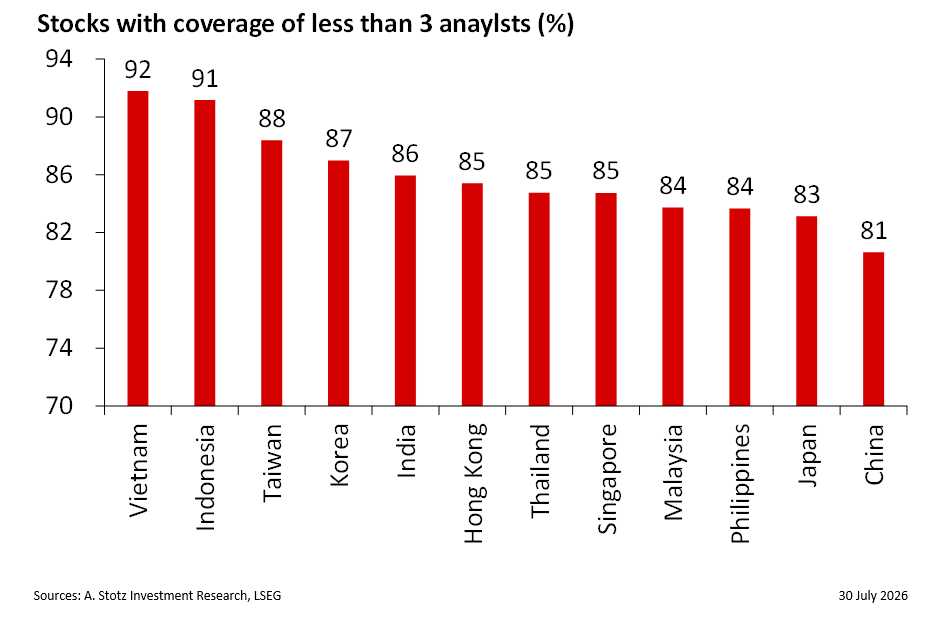
The uncovered share ranges from 81% in China, the region’s largest and most liquid market, to 92% in Vietnam. Every market in our sample is above 80%. Coverage is scarce almost everywhere, not just in a few markets.
Understanding the coverage gap
Analyst coverage is a limited resource, and brokers concentrate it where it pays off: the largest, most liquid, most heavily traded names. As the number of listed companies grows, research capacity doesn’t grow with it. Small and mid-sized companies are the first to fall through, not because they’re poor businesses, but because there’s little commercial incentive for a broker to cover them.
Market inefficiency as an advantage
Uncovered doesn’t mean uninvestable; it means under-researched. That’s the premise Uncovered Thai Stocks is built on, and the same logic applies across the region. Markets with the widest gaps (Vietnam, Indonesia, Taiwan) may hold the largest pool of companies still waiting to be discovered by investors. Even China, the most-covered market here, still leaves four out of five listed companies without adequate coverage.
When the gap closes, it closes quickly
Coverage tends to be triggered rather than earned gradually; a company can improve steadily for years with no new attention, then cross a threshold and gain additional analyst coverage in a short window. That threshold is often tied to size or trading volume: many institutional investors are restricted from buying below it, so a company can improve for years without new demand. When it finally crosses that line, the resulting attention and the buyers who were previously excluded can sometimes arrive all at once. Investors who did the work before that point had the field largely to themselves.
The reality of illiquidity
None of this comes without risks, as we’ve identified in our previous article, Risks and Potential Rewards Investing in Uncovered Thai Stocks. Uncovered stocks are thinly traded by nature. Low volume can mean a narrow exit door when sentiment turns, and it raises the risk of price manipulation. Many are also closely held, with founding families or a small group of shareholders controlling the majority of free float, which limits the number of shares genuinely available to trade. These aren’t reasons to avoid the space; they’re reasons to size positions carefully and expect a long holding period.
The opportunity ahead.
Uncovered Thai Stocks is one answer to this gap, in one market. This data shows the same gap exists across Asia at scale. Closing it, market by market, is the opportunity we see ahead.