

คลิกเพื่ออ่านบทความฉบับภาษาไทย
A nation entering old age, fast
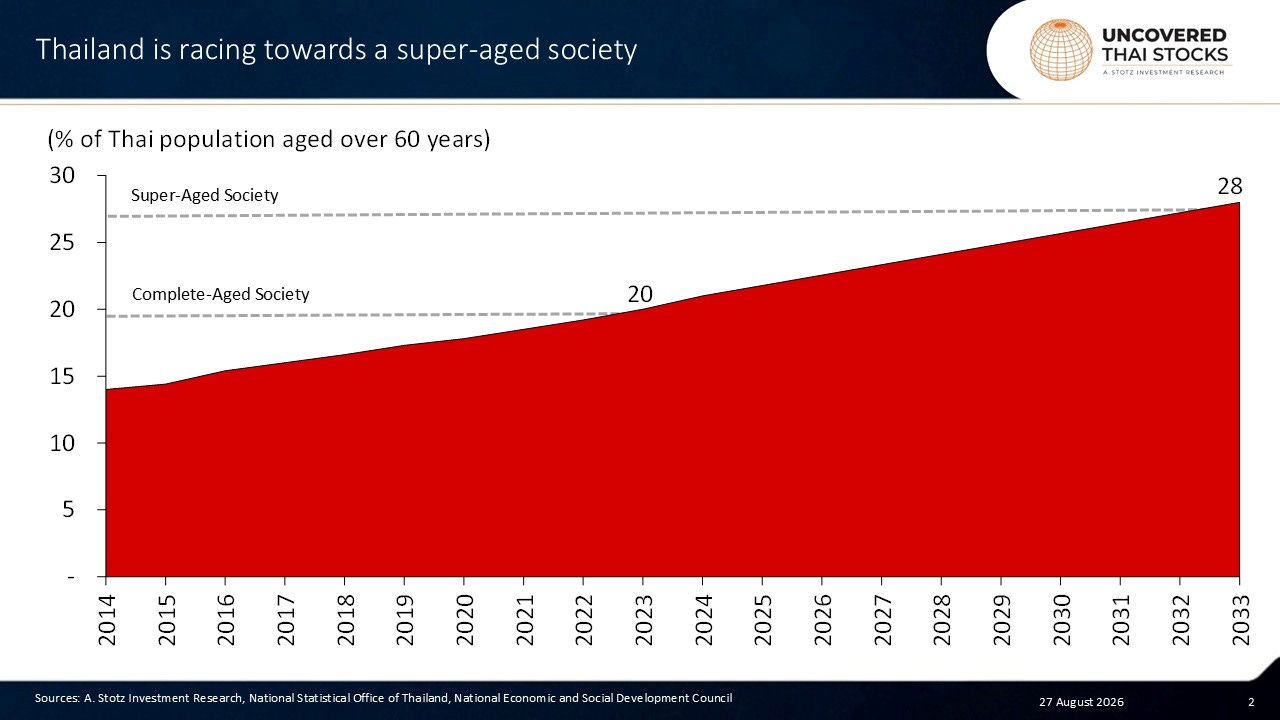
Thailand’s healthcare system is expanding on two fronts. At home, the country entered what demographers classify as a Complete-Aged Society in 2023, a threshold reached when the population aged 60 and older reaches 20% of the total population. The National Economic and Social Development Council (NESDC) projects that Thailand will enter a Super-Aged Society by 2033, when that share reaches 28%, or roughly one in four people in the country.
Non-communicable diseases such as cardiovascular disease, diabetes, and cancer already account for over 76% of deaths nationwide, and an older population means more of these chronic conditions to manage.
Strengthening Thailand’s wellness hub status
Thailand continues to develop into a regional health and wellness hub. The Department of Health Service Support has outlined a strategy to extend medical treatment visas beyond one year, allow private hospitals to establish research and innovation centers, and build centralized international health insurance platforms.
Krungsri Research forecasts that Thailand’s wellness industry will generate Bt760bn by 2027, more than double its 2023 level. Bangkok Dusit Medical Services PCL (BDMS) and Bumrungrad Hospital PCL (BH), Thailand’s two largest listed hospital operators, already generate 31% and 66% of their respective revenues from international patients.
Where opportunities may be hiding
Thailand’s aging population and its ambitions as a wellness hub both rely on the same infrastructure: hospital beds, diagnostic capacity, and specialist staff. That reliance makes this a lasting structural shift, and it’s also where the opportunity lies: in four names beyond the two large caps already mentioned.
KT Medical Service PCL (KTMS) ranked 8th out of 300 uncovered Thai stocks. KTMS operates hemodialysis centers across Thailand, as well as a smaller water-treatment and medical-equipment installation business.
Wattanapat Hospital Trang PCL (WPH) ranked 11th out of 300 uncovered Thai stocks. WPH operates three private hospitals across Thailand’s southern tourist coast: its flagship in Trang, plus facilities in Krabi and on Koh Samui, offering specialized care from endocrinology and dialysis to rehabilitation and dental services. Watch our Business DNA interview with Deputy CEO and CFO Chane Laosonthorn.
Ratchaphruek Hospital PCL (RPH) ranked 33rd out of 300 uncovered Thai stocks. Known locally as the “Healing Environment Hospital,” RPH is a JCI- and Global Healthcare Accreditation-certified private hospital in Khon Kaen, northeastern Thailand, offering a broad range of specialized medical care.
Sikarin PCL (SKR) ranked 34th out of 300 uncovered Thai stocks. SKR operates three private hospitals: its JCI-accredited flagship in Bangna, Bangkok, plus facilities in Samut Prakan and Hat Yai in the south.
Between them, these four companies span the country: a nationwide dialysis network, plus regional hospital groups anchoring the south, the northeast, and Bangkok’s periphery.
The constraint to growth
The country’s healthcare system faces a persistent workforce shortage. According to Mahidol University, Thailand has roughly one doctor per 2,000 people, well below the World Health Organization’s recommended ratio of one per 1,000.
That gap widens sharply outside Bangkok. Doctors are plentiful in Bangkok, at 1 per 462 people, but far scarcer in the provinces, with only 1 per 5,000 in places such as Bueng Kan. Even as hospital groups invest in new capacity, a shortage of doctors and specialized nurses could limit how quickly that capacity can be utilized.
Off the radar, for now
The demographic shift underway here and the wellness hub ambitions behind it are well documented. The large caps capture almost all of the analyst attention that accompanies that story. What’s far less documented is where the exposure sits beyond the large-cap hospitals: in regional operators serving the same aging population and the same rising burden of chronic disease.
KTMS, WPH, RPH, and SKR each offer a distinct angle on that structural story: a dialysis specialist in a country where chronic kidney disease now affects about 18% of adults; a long-serving southern provincial hospital; a northeastern operator; and a Bangkok-adjacent hospital group.
Besides being potential beneficiaries from these structural trends, none of the stocks have analyst coverage. This is what Uncovered Thai Stocks is about: identifying interesting stocks before they’re covered by analysts. We also hope to serve as a resource where analysts can find interesting ideas for their coverage.