

คลิกเพื่ออ่านบทความฉบับภาษาไทย
The FVMR® framework cuts through the noise. Rather than reacting to headlines, it focuses on what actually matters: companies’ profitability, the price paid for that profitability, whether the trend is moving in the right direction, and market risk. Most investors focus on price alone: FVMR® gives the complete picture.
Every week, A. Stotz Investment Research updates the Thailand Equity FVMR® Snapshot. Here is what the data shows as of 16 October 2026.
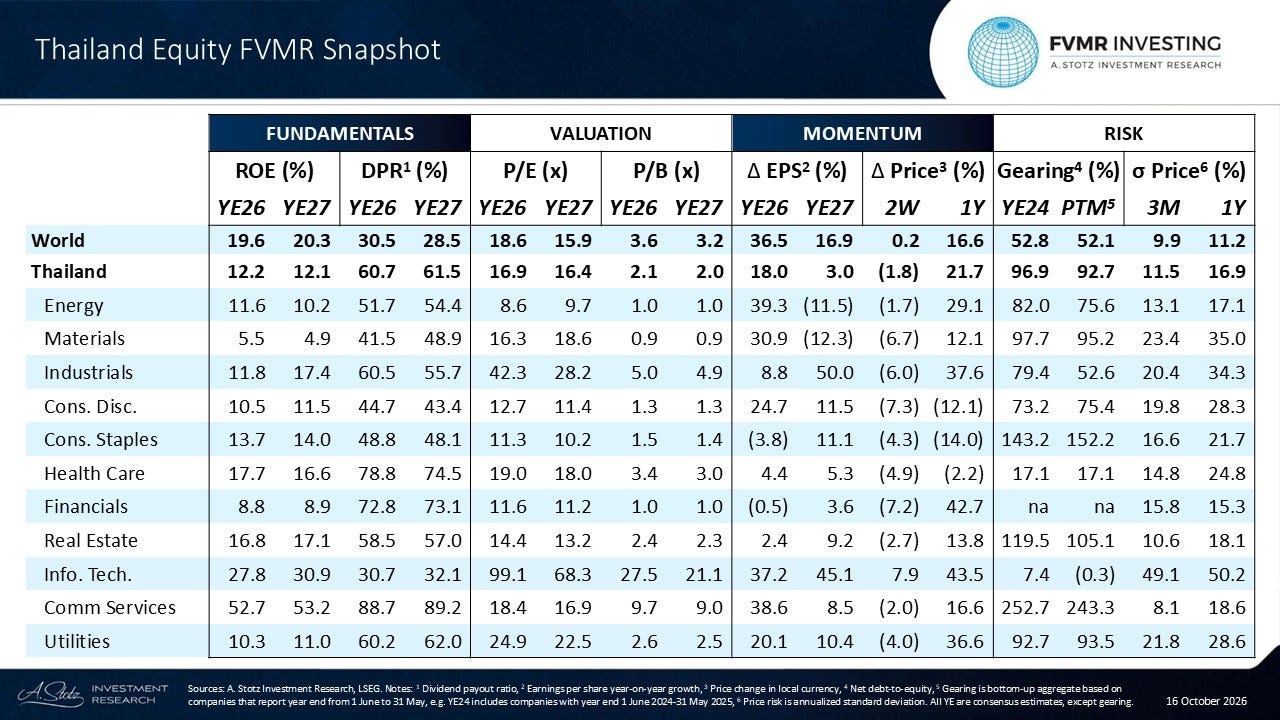
The Thailand Equity FVMR® Snapshot is produced by A. Stotz Investment Research using LSEG data. All YE (year-end) figures are consensus estimates, except for gearing (net debt-to-equity).
Fundamentals
Consensus estimates place Thailand’s year-end 2026 (YE26) return on equity (ROE) at 12.2%, well below the world average of 19.6%. Part of the gap reflects market mix, with lower-return sectors accounting for a large share of the Thai market. Energy, Financials, Materials, and Utilities together make up roughly 43% of the total, and all four are expected to earn lower ROEs than the market overall, at 11.6%, 8.8%, 5.5%, and 10.3%, respectively.
At 60.7%, Thailand’s dividend payout ratio (DPR) is nearly double the world average of 30.5%. Thai companies return more than half of their profits to shareholders as dividends. That is typical of mature, income-oriented businesses rather than high-growth companies reinvesting for expansion. Communication Services stands out on both measures, with the highest ROE at 52.7% and the highest DPR at 88.7%.
Valuation
Thailand trades at a YE26 price-to-earnings (PE) ratio of 16.9x, a slight discount to the world average of 18.6x. The discount is wider on price-to-book (PB), at 2.1x versus the world average of 3.6x. This mirrors the ROE gap: when companies earn lower returns on their net assets, investors pay less for them. Thailand’s PB-to-ROE ratio, the price paid for each point of ROE, is 0.17x, close to the world average of 0.18x.
Energy is the cheapest sector at 8.6x PE, while Information Technology is the most expensive at 99.1x, followed by Industrials at 42.3x. Information Technology’s valuation is driven largely by Delta Electronics (DELTA), Thailand’s largest listed company. Even after pulling back from its June 2026 peak, Delta’s shares are up 33.1% over the past year on AI optimism, and the company still trades at a high price relative to its current earnings.
Momentum
The YE26 earnings per share (EPS) growth estimate of 18.0% lags the world average of 36.5%. Consensus expects growth to slow to 3.0% in year-end 2027 (YE27), compared with the world average of 16.9%. Thai equities are up 21.7% over the past year, ahead of the world average of 16.6%. Information Technology and Financials are among the top performers over the past year, with returns of 43.5% and 42.7%, respectively.
Risk
Gearing (net debt-to-equity) is high at 92.7% over the past 12 months, compared with the world average of 52.1%. This level is worth watching given Thailand’s below-average profitability. Price volatility is moderate at 11.5% over three months, somewhat above the world average of 9.9%. Communication Services is the least volatile sector at 8.1%, while Information Technology is the most volatile at 49.1%.